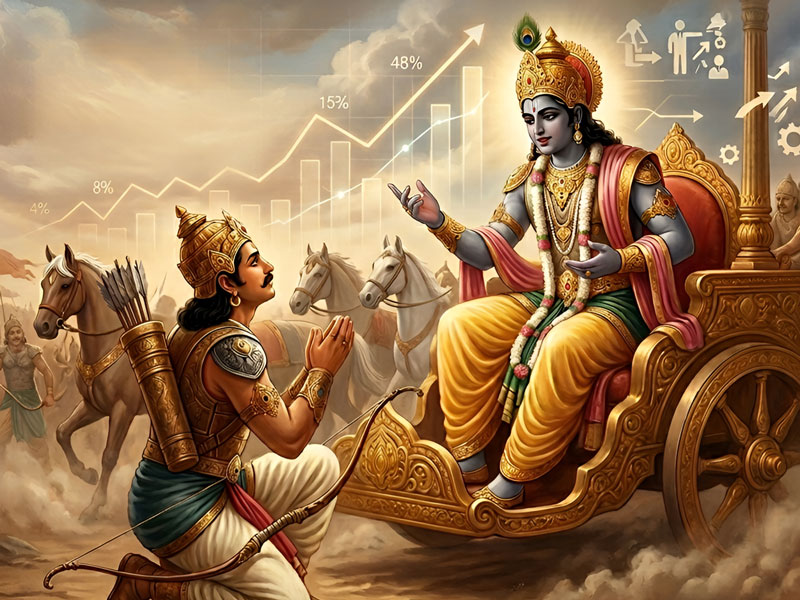
Five thousand years before the first MBA was awarded, a warrior-prince sat frozen on a battlefield. Arjuna — the greatest archer of his generation, commander of armies, heir to a kingdom — refused to act. Across from him stood family, mentors, and friends. The cost of victory looked unbearable. The cost of retreat looked dishonourable. He did what every modern executive has done in the small hours before a difficult decision: he asked for counsel.
What followed was not a pep talk. It was a 700-verse dialogue on the architecture of decision-making, the psychology of action, and the discipline of staying clear-headed when stakes are existential. The Bhagavad Gita is, at its core, a leadership text. It just happens to be wrapped in the metaphor of a battlefield — which, for anyone leading a company, a team, or a turnaround, may be the most honest metaphor available.
These twelve teachings are not religious instruction. They are operating principles, road-tested across two millennia of human ambition, ego, and consequence. Read them as you would read Drucker, Stoicism, or Clayton Christensen — as field-tested frameworks for the work you actually do.
Frequently Asked Questions
What does the Bhagavad Gita teach about leadership?
The Bhagavad Gita teaches that true leadership is rooted in duty (dharma), clarity of purpose, and equanimity under pressure. A leader acts decisively without being attached to outcomes, leads by personal example, and stays emotionally steady through both success and failure.
Can ancient Indian philosophy work in modern corporate settings?
Yes. The Gita's frameworks on duty, detachment from results, and self-mastery map directly onto modern challenges such as decision fatigue, burnout, ethical dilemmas, and high-stakes negotiation. The principles are timeless because they address human nature, not historical context.
What is karma yoga and how does it apply to business?
Karma yoga is the discipline of skillful action performed without obsessive attachment to results. In business, it translates to executing with full commitment while accepting that outcomes depend on many factors beyond your control. This mindset reduces anxiety and improves long-term decision quality.
How can executives apply Gita teachings without being religious?
The Gita's leadership principles are philosophical and behavioural, not devotional. Executives can adopt frameworks such as detached action, sva-dharma (authentic role), and equanimity as pure mental models without engaging with any religious practice.
Which Bhagavad Gita verse is most relevant for entrepreneurs?
Chapter 2, Verse 47 is the most cited for entrepreneurs. It states that you have the right to perform your duties but not to the fruits of those actions. For founders facing uncertainty, this means committing fully to the work while staying psychologically free from outcomes you cannot fully control.
Is the Bhagavad Gita taught in business schools?
Yes. Several leading institutions including the Indian Institutes of Management and global programs at Harvard, Wharton, and INSEAD have incorporated Gita-based leadership modules into ethics, decision-making, and self-leadership curricula.