Eid ul Adha 2026 Greeting Cards & Eid Mubarak Wishes
Send beautiful Eid ul Adha cards and heartfelt Eid Mubarak messages to your family, friends & colleagues via WhatsApp, Facebook, and Instagram.
27 May 2026 · Wednesday (Moon-sighting dependent)
🌙 Celebrate the Festival of Sacrifice with Heartfelt Wishes
Eid ul Adha 2026 — also called Bakrid, Eid al-Adha, or the Festival of Sacrifice — is expected to fall on Wednesday, 27 May 2026, subject to the official sighting of the crescent moon of Dhul Hijjah. Share your joy, faith, and blessings with loved ones near and far using our collection of free Eid ul Adha greeting cards, Eid Mubarak wishes, and WhatsApp messages.
Eid ul Adha is one of the two most important festivals in Islam, commemorating the profound devotion of Prophet Ibrahim (AS) and his willingness to sacrifice his son Ismail (AS) in obedience to Allah's command. At the final moment, Allah replaced Ismail with a ram — a divine sign of mercy and reward for unshakeable faith. This sacred story is the heart of Eid ul Adha and inspires Muslims worldwide to perform Qurbani (ritual sacrifice), give to the needy, and celebrate with family and community.
Eid ul Adha 2026 — Key Dates
Dhul Hijjah Begins
18 May 2026
Mon (est.), subject to moon sighting
Day of Arafah
26 May 2026
Tue · 9th Dhul Hijjah · Hajj climax
Eid ul Adha 2026
27 May 2026
Wed · 10th Dhul Hijjah · Main Eid day
Celebration Period
27–30 May 2026
3–4 days · ends Fri/Sat 30 May
Free Eid ul Adha 2026 Greeting Cards
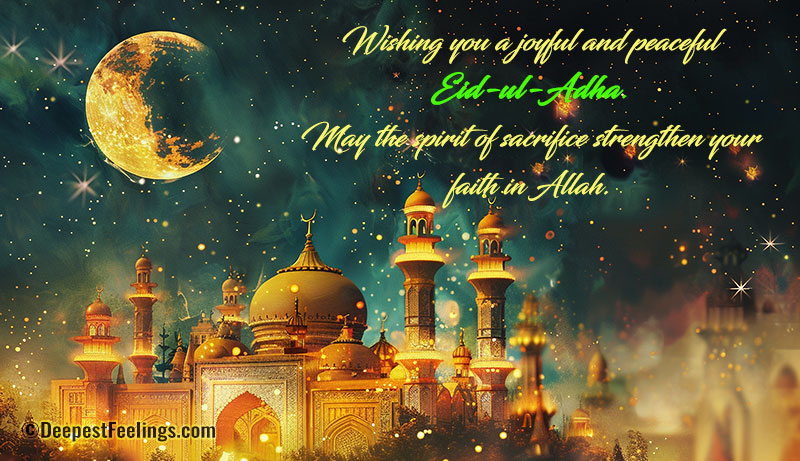
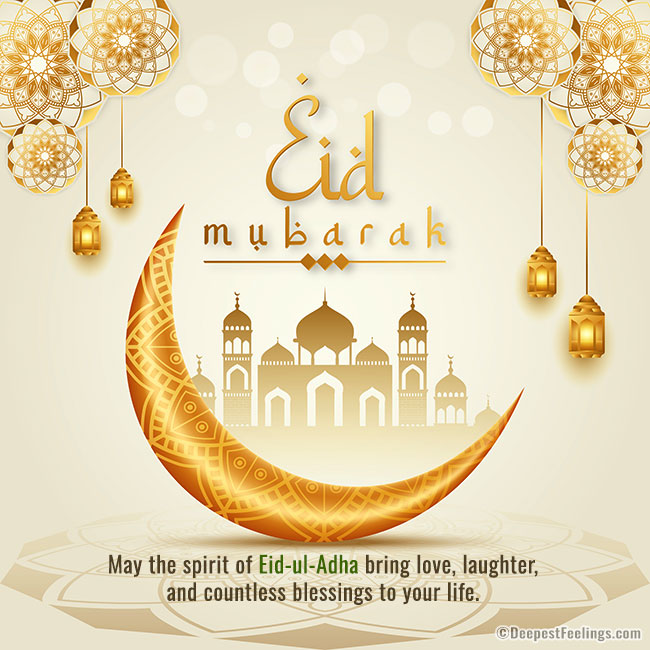
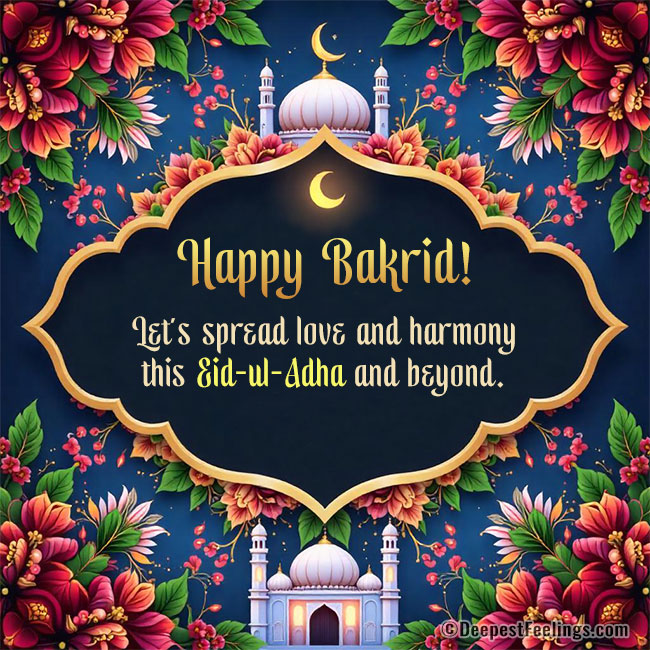
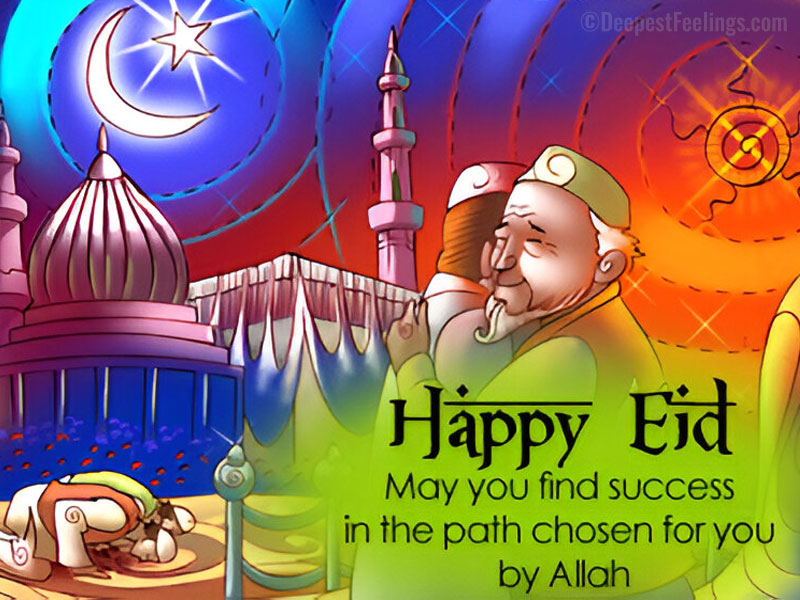
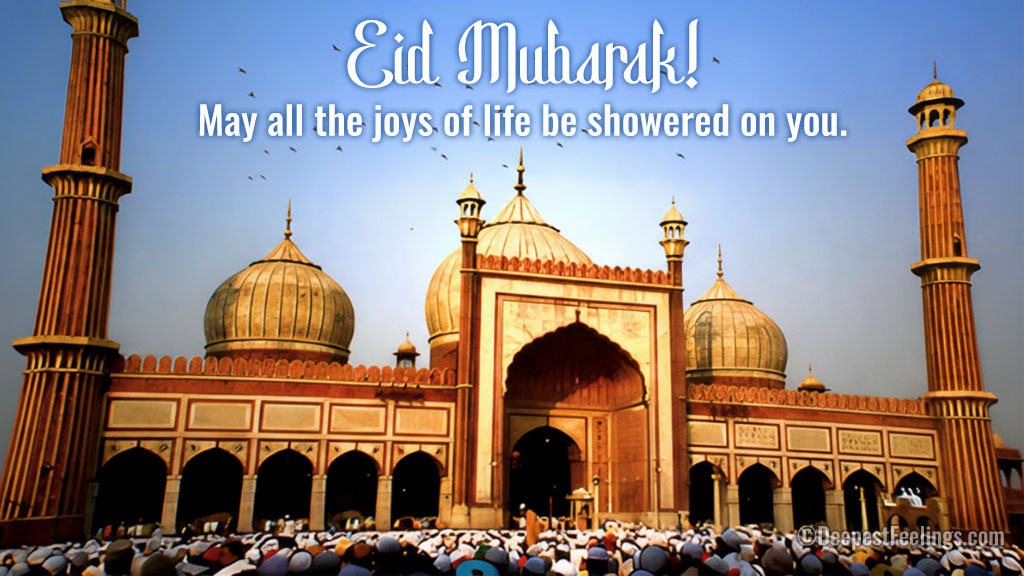
Download and share these beautiful Eid ul Adha 2026 greeting cards on WhatsApp, Facebook, Instagram, or print them at home. Each card carries a unique Eid Mubarak wish to brighten someone's celebration.
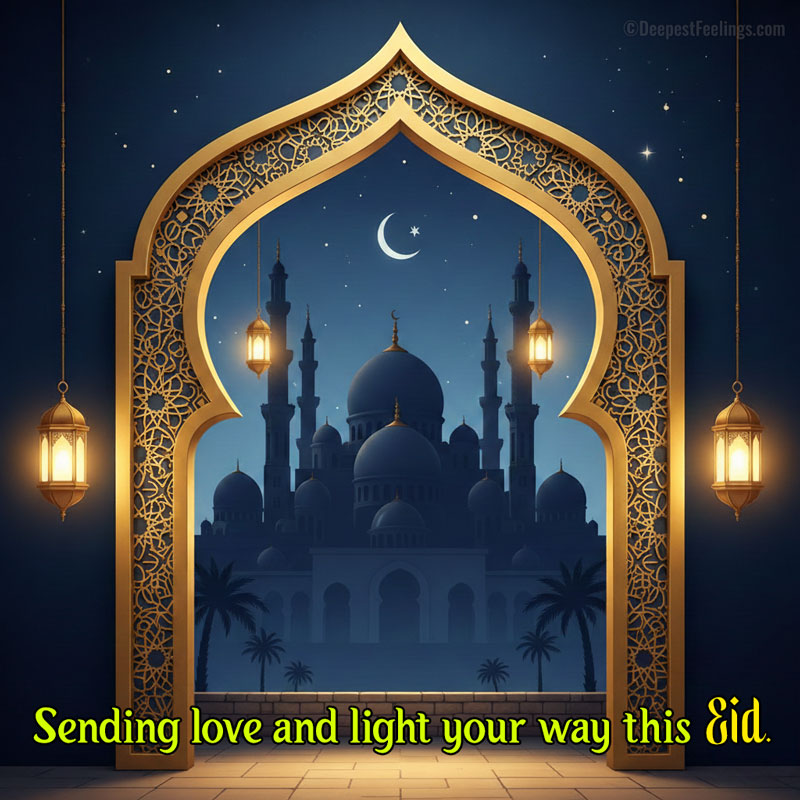
"Sending love and light your way this Eid ul Adha. May Allah fill your home with peace, your heart with gratitude, and your life with endless blessings."
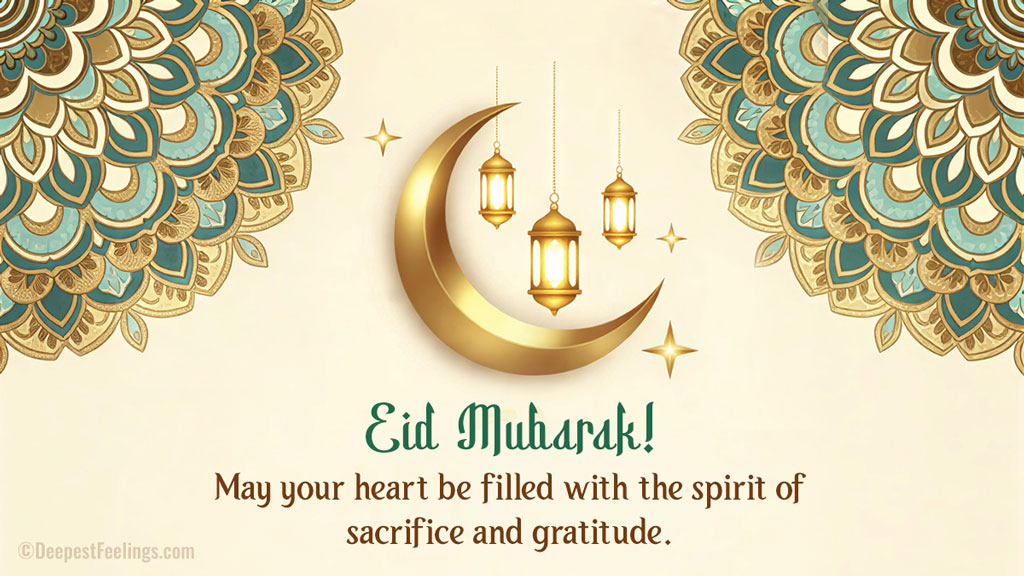
"Eid Mubarak! May all the joys of life be showered on you. May Allah accept your qurbani, grant your duas, and keep your family in the shade of His mercy."
Find the perfect Eid ul Adha message for every relationship. Copy any wish below and share it on WhatsApp, Instagram, Facebook, or as an SMS to spread the joy of Eid Mubarak 2026.
Eid Mubarak Wishes for WhatsApp Status & Captions
🌙 Eid Mubarak! May this blessed day bring peace, prosperity, and endless happiness to your life. May Allah accept your sacrifices and grant all your heartfelt prayers.
✨ Wishing you an Eid ul Adha filled with love, light, and countless blessings. Taqabbal Allahu minna wa minkum — May Allah accept from us and from you. Eid Mubarak 2026!
🤲 May Allah accept your prayers, your qurbani, and your acts of charity. Have a joyful, peaceful, and blessed Eid ul Adha 2026.
🌸 Eid ul Adha is a reminder of gratitude, sacrifice, and the beauty of surrender to Allah. Wishing you a very happy and meaningful Eid! 🕌
🕊️ May your heart be filled with faith, your home with harmony, and your life with the barakah of Allah this Eid ul Adha and always. Eid Mubarak!
💫 On this Eid ul Adha 2026, may Allah reward your devotion, forgive your shortcomings, and open the doors of His mercy and prosperity for you and your loved ones.
🌟 Let's celebrate Eid with a thankful heart and a generous spirit. May we remember the lesson of Ibrahim (AS) — that true faith requires trust and sacrifice. Eid Mubarak to all!
🕌 May this Eid bring new hopes, new beginnings, and countless smiles. May the joy of Bakrid 2026 fill your home with laughter and your heart with contentment.
🌼 Peace, love, and blessings to you and your family on this special day. May Allah grant you health, success, and happiness in abundance. Eid Mubarak!
🎉 Eid vibes only — joy in the heart, prayers on the lips, qurbani in the spirit, and smiles all around! Wishing you the happiest Eid ul Adha 2026.
Eid ul Adha Wishes for Family
❤️ Eid Mubarak to my beloved family! May Allah fill our home with peace, love, and endless blessings. Grateful to celebrate this beautiful occasion with the people I love most.
🤗 To my dearest family — Eid Mubarak 2026! May Allah always protect us, keep us united in love and faith, and shower His mercy on every member of our family.
🌹 Wishing our family a joyful Eid ul Adha filled with happiness, togetherness, and the barakah of Allah. May this Eid strengthen our bonds and deepen our faith.
🙏 Dear parents and elders — Eid Mubarak! May Allah bless you with health, happiness, and a long life filled with peace. Your prayers and sacrifices mean the world to us.
Eid ul Adha Wishes for Friends
😊 Eid Mubarak my dear friend! May your life be filled with happiness, success, and endless blessings this Eid ul Adha. Grateful to have a friend like you — stay blessed always!
🌙 Wishing you and your family a joyful Eid full of laughter, love, and delicious moments together. May Allah bless you with everything good! Happy Bakrid 2026!
🎊 Happy Eid ul Adha to my amazing friend! May this Eid bring you closer to your dreams, fill your heart with positivity, and reward your faith and patience. Eid Mubarak!
Formal Eid Mubarak Greetings for Colleagues
🌿 Wishing you and your family a blessed and joyous Eid ul Adha 2026. May this occasion be a time of reflection, generosity, and renewed purpose. Eid Mubarak!
📿 On behalf of our team, we wish you and your family a very happy Eid ul Adha. May this sacred festival bring peace, unity, and prosperity to your home. Eid Mubarak 2026.
🌟 Sending warm Eid Mubarak greetings to you and your loved ones on this holy occasion of Eid ul Adha. May your faith be renewed and your blessings multiplied.
Traditional Arabic Eid Greetings
تَقَبَّلَ اللهُ مِنَّا وَمِنْكُمْ
Taqabbal Allahu minna wa minkum
May Allah accept (good deeds) from us and from you — the most traditional Eid greeting exchanged between Muslims.
عيد مبارك وعيد سعيد
Eid Mubarak wa Eid Saeed
Blessed Eid and Happy Eid — a warm, universally understood Eid greeting used across the Muslim world.
كل عام وأنتم بخير
Kull aam wa antum bi-khayr
May you be well every year — a general blessing used across Islamic holidays and celebrations.
The Significance of Eid ul Adha — Festival of Sacrifice
Eid ul Adha, meaning "Festival of Sacrifice" in Arabic, is the holier of the two Eids in Islam — often called Eid al-Kabir (The Greater Eid) across the Arab world. It falls on the 10th of Dhul Hijjah, the 12th and final month of the Islamic lunar calendar, and commemorates one of the most powerful stories in the Abrahamic tradition.
According to Islamic scripture (Surah As-Saffat 37:102), Prophet Ibrahim (AS) received a divine command in a dream to sacrifice his beloved son, Ismail (AS). Both father and son, in complete submission to Allah's will, prepared to fulfill this command. At the final moment, Allah — pleased with their unwavering faith — sent the Angel Jibreel with a ram to replace Ismail as the sacrifice. This act of tawakkul (trust in Allah) and total submission remains one of the most profound examples of faith in Islamic tradition.
In remembrance of this sacrifice, and to draw closer to Allah, Muslims around the world perform Qurbani (the ritual slaughter of an animal) on the days of Eid ul Adha. The meat is traditionally divided into three equal portions: one-third for your own family, one-third for relatives and friends, and one-third for those in need — ensuring that everyone in the community can share in the joy of Eid.
How is Eid ul Adha Celebrated?
Eid ul Adha begins with a special Salat al-Eid (Eid prayer) in congregation, held at mosques, open grounds, or large prayer halls. The Prophet Muhammad (PBUH) recommended several sunnah acts for this blessed day: performing Ghusl (ritual bath) before Eid prayer, wearing your best and cleanest clothes, reciting the Takbeer ("Allahu Akbar") while walking to the prayer ground, and delaying breakfast until after the Eid prayer (unlike Eid ul Fitr, where eating before the prayer is recommended).
Following the Eid prayer, Muslims perform the Qurbani sacrifice, which can be carried out on the 10th, 11th, 12th, or 13th of Dhul Hijjah. Celebrations continue with family feasts, exchanging Eid gifts, visiting friends and relatives, and giving to charity. Many countries have unique traditions — in Pakistan and India, henna (mehndi) is applied, while in Egypt it is customary to visit the graves of relatives to offer prayers.
Eid ul Adha also coincides with the completion of Hajj — the annual pilgrimage to Mecca, Saudi Arabia, which is one of the five pillars of Islam. While pilgrims on Hajj observe the rituals at Mina, Muzdalifah, and Mecca, the rest of the Muslim world joins in the spirit of Eid, united in prayer and celebration.
Eid ul Adha — Names Around the World
Eid ul Adha is known by many names depending on the country and language. All refer to the same blessed festival of sacrifice and faith:
Regional names for Eid ul Adha / Eid al-Adha worldwide
Name
Region / Language
Meaning
Eid ul Adha / Eid al-Adha
Standard Arabic / Global
Festival of Sacrifice
Bakrid / Bakra Eid
India, Pakistan, Bangladesh
Goat festival (from "Bakra" = goat)
Eid al-Kabir / Eid el-Kebir
Arab world, North Africa
The Greater Eid
Tabaski
West Africa (Senegal, Nigeria, Gambia)
Local name for the Festival of Sacrifice
Kurban Bayramı
Turkey, Central Asia
Festival of Sacrifice (from "kurban" = sacrifice)
Eid Qurban
Malaysia, Indonesia, Brunei
Festival of Sacrifice
Tfaska Tamoqqrant
North Africa (Berber / Amazigh)
The Great Festival
Eid ul Zuha / Eid uz Zuha
South Asia, Urdu speakers
Festival of Sacrifice (zuha = dawn, referring to Ibrahim's sacrifice)
Frequently Asked Questions about Eid ul Adha 2026
Eid ul Adha 2026 is expected to fall on Wednesday, 27 May 2026 (10th of Dhul Hijjah, 1447 AH). This is subject to the official sighting of the crescent moon of Dhul Hijjah. The celebration period runs from 27 to 30 May 2026 (three to four days). The Day of Arafah (9th Dhul Hijjah, the most sacred day of Hajj) falls on Tuesday, 26 May 2026.
Eid ul Adha, also called the Festival of Sacrifice, is one of the two major Islamic holidays. It commemorates Prophet Ibrahim's (AS) willingness to sacrifice his son Ismail (AS) as an act of obedience to Allah. At the final moment, Allah sent a ram to replace Ismail, rewarding Ibrahim's faith. Muslims worldwide celebrate by performing Eid prayers, carrying out Qurbani (ritual animal sacrifice), sharing meat with the needy, and exchanging Eid Mubarak greetings. It coincides with the completion of the annual Hajj pilgrimage to Mecca.
Qurbani (also called Udhiyah) is the ritual slaughter of an animal — sheep, goat, cow, buffalo, or camel — performed on the 10th to 13th of Dhul Hijjah. Under the Hanafi school, it is obligatory (wajib) for every sane adult Muslim who possesses wealth above the nisab threshold (approximately equivalent to 87.48g of gold or 612.36g of silver). A single sheep or goat counts for one household; a cow or camel can be shared by up to seven people. The meat is divided into three portions: one for the family, one for relatives and friends, and one for the poor and needy. It is recommended to sacrifice as early as possible after the Eid prayer on the 10th of Dhul Hijjah.
"Eid Mubarak" (عيد مبارك) means "Blessed Eid" in Arabic. It is the most common Eid greeting exchanged between Muslims worldwide. You can respond with "Eid Mubarak" (returning the same wish) or "Khair Mubarak" (may goodness be blessed to you too) or the fuller traditional phrase "Taqabbal Allahu minna wa minkum" (May Allah accept from us and from you). Another common response is "Wa antum min ahlihi" (And may you be among its people, i.e., may you be deserving of it too).
The Day of Arafah (Yawm Arafah) is the 9th of Dhul Hijjah — in 2026, this falls on Tuesday, 26 May 2026. It is the most sacred day of Hajj, when pilgrims gather on the plain of Arafat near Mecca to pray, seek forgiveness, and make dua. For Muslims not performing Hajj, fasting on the Day of Arafah is a highly recommended Sunnah. The Prophet Muhammad (PBUH) said that fasting on this day expiates the sins of the previous year and the coming year (Sahih Muslim). It is the pinnacle of worship during the blessed first ten days of Dhul Hijjah.
Eid ul Fitr marks the end of the holy month of Ramadan (fasting) and is celebrated on the 1st of Shawwal. Eid ul Adha commemorates Prophet Ibrahim's sacrifice and falls on the 10th of Dhul Hijjah, coinciding with the completion of Hajj. Eid ul Adha is considered the "Greater Eid" (Eid al-Kabir) and lasts 3–4 days. It involves Qurbani (animal sacrifice) which is not part of Eid ul Fitr. During Eid ul Fitr, it is Sunnah to eat before the Eid prayer; during Eid ul Adha, it is Sunnah to eat after the prayer (from the Qurbani meat). Zakat al-Fitr (Fitrana) is paid during Eid ul Fitr, while Qurbani obligation applies to Eid ul Adha.
The recommended sunnah acts for Eid ul Adha include: (1) Performing Ghusl (full bath) before the Eid prayer. (2) Wearing your best, clean clothes. (3) Applying attar (perfume). (4) Reciting the Takbeer aloud while walking to the prayer ground: "Allahu Akbar, Allahu Akbar, La ilaha illAllah, Allahu Akbar, Allahu Akbar, wa lillahil hamd." (5) Delaying eating until after the Eid prayer (unlike Eid ul Fitr). (6) Performing the congregational Eid prayer. (7) Giving Qurbani (sacrifice) as soon as possible after the Eid prayer. (8) Distributing Qurbani meat to family, friends, and those in need. (9) Visiting family and friends. (10) Exchanging Eid Mubarak greetings and well-wishes.